
PlanningConsult · In development
Check the constraints before you commit.
It isn’t finished, and it isn’t open to customers yet.
Read the transcript
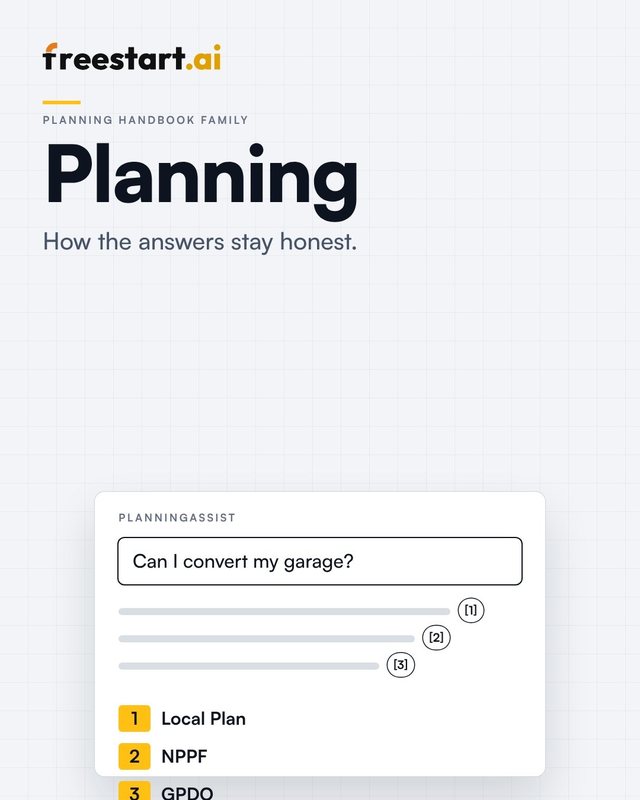
Planning rules are long, local and easy to get wrong.
So we read the rulebook first, in short passages, each tagged with where it came from.
Each passage is filed by meaning, so a question finds the right policy even when it's phrased differently.
Answers come only from what we find, and every point cites its source.
If nothing matches well enough, it says so instead of guessing.
PlanningAssist and PlanningConsult both answer this way.
The method is designed to apply to any rulebook, like HR policy.
PlanningConsult is a planning tool for planning professionals, in development. It takes a postcode, checks the site against statutory planning constraints, then drafts a planning statement that cites the local plan and national policy it relies on.
Postcode
Constraints
Planning statement
Local PlanNPPFA postcode is where it starts.
Each point tied to the policy behind it.
Statutory planning constraints, checked for the site.
What it checks
- Conservation areas
- Listed buildings
- Article 4 directions
- Tree preservation
- Green belt
- National landscapes and national parks
- SSSIs
- Flood zones
- Ancient woodland
- Scheduled monuments
- Registered parks and gardens
- Registered battlefields
- Protected habitats
“Areas of Outstanding Natural Beauty” are now “National Landscapes”.
The planning statement
For a planning professional, it works out which council’s plan applies, finds the policies that govern the site, and drafts a statement in the usual structure with each point tied to the policy behind it.
347 of 361 planning authorities (96%).
Where it stands
PlanningConsult is in development. It is part of the Planning Handbook family: read the guidance, ask PlanningAssist, then check the site.
In development means it isn’t finished.
It follows the same method as all our planning work: read the rulebook, file it by meaning, and answer only from what it finds.
How the answers stay honest →In a planning statement, a quote that doesn’t match the policy has its citation removed.
- ReadPlanning Handbook ↗Guidance
- AskPlanningAssistBeta
- CheckPlanningConsultIn development
Like Planning Handbook, it doesn’t make planning decisions, give legal advice or guarantee outcomes.
Questions
Questions about PlanningConsult
Email hello@freestart.ai, ring 0330 223 8390 or use the contact page.
What is PlanningConsult?
PlanningConsult is a planning tool for planning professionals, in development. It takes a postcode, checks the site against statutory planning constraints, then drafts a planning statement that cites the local plan and national policy it relies on. It is part of the Planning Handbook family and isn’t open to customers.
Which planning constraints does PlanningConsult check?
It checks a site for conservation areas, listed buildings, Article 4 directions, tree preservation, green belt, national landscapes and national parks, SSSIs, flood zones, ancient woodland, scheduled monuments, registered parks and gardens, registered battlefields and protected habitats. Areas of Outstanding Natural Beauty are now called National Landscapes.
How does PlanningConsult draft a planning statement?
It works out which council’s plan applies to the site, finds the policies that govern it, and drafts a statement in the usual structure, with each point tied to the policy behind it. Any quote in the statement must closely match a stored policy passage, or its citation is removed.
Can I use PlanningConsult now?
Not yet. PlanningConsult is in development, which means it isn’t finished, and it isn’t open to customers. It answers the same way as PlanningAssist, which is in beta and free to ask: only from the policy passages it finds, with a source for every point. If you work in planning and want to talk about it, contact us.
Does PlanningConsult make planning decisions?
No. Like Planning Handbook, PlanningConsult doesn’t make planning decisions, give legal advice or guarantee outcomes. It drafts a statement that shows which policy each point rests on, so a planning professional can check it. Planning decisions are made by the local planning authority.