
Planning
Planning answers from the policy itself.
PlanningAssist is in beta; PlanningConsult is in development.
Read the transcript
Planning rules are long, local and easy to get wrong.
So we read the rulebook first, in short passages, each tagged with where it came from.
Each passage is filed by meaning, so a question finds the right policy even when it's phrased differently.
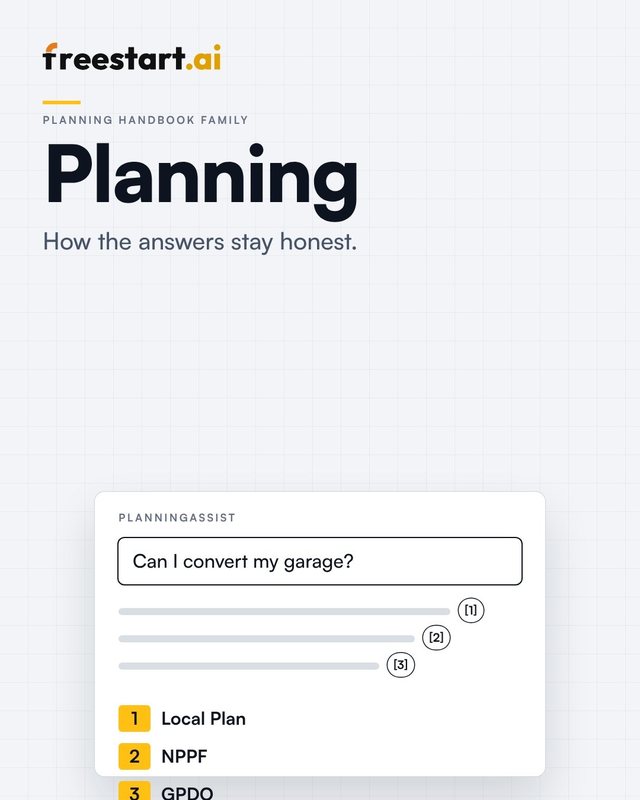
Answers come only from what we find, and every point cites its source.
If nothing matches well enough, it says so instead of guessing.
PlanningAssist and PlanningConsult both answer this way.
The method is designed to apply to any rulebook, like HR policy.
PlanningAssist (beta) and PlanningConsult (in development) are the planning tools in the Planning Handbook family. Both are built to answer from the local plan and national policy, and show their sources.
How the answers stay honest.
Every answer starts from the policy itself. Anything we publish is checked again, claim by claim.
How every answer is found
We read the rulebook first.
Local plans, national policy and official guidance are broken into short passages, each tagged with where it came from.
347 of 361 planning authorities (96%).
We file it by meaning.
Each passage is indexed by what it means, not only the words it uses, so a question finds the right policy even when it’s phrased differently. Exact keyword search runs alongside.
We answer only from what we find.
Answers are written from the passages we retrieve, and every point cites its source. If nothing matches well enough, it says so instead of guessing.
PlanningAssist and PlanningConsult answer this way.
How published guidance is checked
PlanningContent adds two more steps before anything is published.
We check every claim.
Before anything is published, the text is split into individual claims and each one is checked against the policy: verified, outdated, unsupported, uncertain or not covered. A second, independent check reviews the result.
A second, independent check reviews the result.
A person signs it off.
An editor sees every verdict and citation, and nothing is published until they approve it.
Nothing is published until an editor approves it.
PlanningContent
PlanningContent writes and refreshes the Planning Handbook’s guidance in our house style, with versions for England, Wales, Scotland and Northern Ireland. Every factual claim is checked against the policy, and nothing is exported until an editor has approved it.
Used by Freestart’s own editors.
Where the method is used
PlanningAssist and PlanningConsult answer the way every answer is found: only from the passages they retrieve, with a source for every point.
PlanningAssist
Ask a planning question, get a plain-English answer with its sources.
Read about PlanningAssist →PlanningConsult
A postcode check against planning constraints, and a drafted planning statement.
Read about PlanningConsult →- ReadPlanning Handbook ↗Guidance
- AskPlanningAssistBeta
- CheckPlanningConsultIn development
Read the guidance, ask PlanningAssist, then check the site.
Beyond planning
The same method works on any rulebook.
Nothing in the method is specific to planning. Read the source documents, index them by meaning, answer only with citations, check every claim, and keep a person in charge of what gets published. It’s designed to apply to HR policy, health and safety and other compliance work, wherever getting a rule wrong matters. Each new rulebook needs its own sources and tests, and we build those with you.
An approach we can apply with you, built and tested for each new rulebook.
Questions
Questions about the planning tools
Email hello@freestart.ai, ring 0330 223 8390 or use the contact page.
How do the planning tools answer questions?
PlanningAssist, in beta, answers only from planning policy we have collected, and PlanningConsult, in development, is built the same way. Local plans, national policy and official guidance are broken into short passages, each tagged with where it came from. A question is matched to passages by meaning and by exact keywords, and the answer is written only from the passages found, with a source for every point.
Which sources do the planning tools use?
They draw on five kinds of source material: law and regulations, including permitted development; adopted local plans; national policy for each UK nation; national practice guidance, including building regulations; and advisory and heritage guidance. A postcode is matched to its planning authority, and national policy is limited to the nation the site is in.
What happens when the policy doesn’t cover a question?
The tools say so instead of guessing. Answers are written only from the passages retrieved, and if nothing matches well enough, the tool declines to answer. A draft whose citations don’t point to a retrieved passage is written again, so every point in an answer has a source you can check.
What is PlanningContent?
PlanningContent writes and refreshes the Planning Handbook’s guidance in our house style, with versions for England, Wales, Scotland and Northern Ireland. It splits each draft into individual claims and checks every one against the policy, and a second, independent check reviews the result. Nothing is exported until an editor has approved it.
Does the method only work for planning?
It isn’t built only for planning. Nothing in the method is specific to planning: read the source documents, index them by meaning, answer only with citations, check every claim, and keep a person in charge of what gets published. It’s designed to apply to HR policy, health and safety and other compliance work. Each new rulebook needs its own sources and tests.